Why Are F-Gases Being Phased Out?
Fluorinated greenhouse gases, or F-gases for short, are used, among other things, as refrigerants in air conditioning and refrigeration systems as well as heat pumps. Many of these substances have a significantly higher global warming potential than CO₂. If they enter the atmosphere – for example through leaks, maintenance or disposal – they contribute directly to global warming.
As global demand for cooling and air conditioning rises, the importance of choosing the right refrigerant is therefore also growing. The European Union is gradually reducing the use of F-gases with particularly high climate impact and promoting the transition to refrigerants with lower climate impact or to non-fluorinated alternatives.
Hazardous release of refrigerants:
The average leakage rate of R-134a in new buses is 13.3% refrigerant per year for overland buses and 13.7% for city buses (Schwarz, Establishment of Leakage Rates of Mobile Air Conditioners in Heavy Duty Vehicles, 2007). According to publications of “Deutsche Umwelthilfe e.V.”, buses across Germany emitted nearly 100 tons of R-134a refrigerant in 2008.
The amount of refrigerant released by buses corresponds to 140,000 tons of CO2 equivalents per year. That corresponds to the annual CO2 emissions of 90,000 fuel efficient compact cars with an average manner of driving.
The massive burning of fossil fuels such as coal and oil — as well as the release of large amounts of chemical refrigerants — is turning the Earth into a greenhouse.
Leading climate experts predict that if industrialised and emerging countries do not drastically reduce their greenhouse gas emissions, the Earth’s average temperature could rise by a further four degrees by the end of this century.
Climate change is affecting regions all over the world. The polar ice caps are melting and sea levels are rising. Some regions are experiencing more frequent extreme weather events and increasing rainfall, while others are facing more intense heatwaves and droughts.
These effects are expected to become even more severe in the coming decades.
According to the Intergovernmental Panel on Climate Change, the oceans have absorbed more than 90 percent of the additional human-made heat from the Earth’s atmosphere since 1970 and have therefore been warming continuously. So-called marine heatwaves are becoming more frequent and more intense.
Ocean warming also means that water layers mix less effectively. As a result, many marine organisms in certain water layers or regions are no longer supplied with sufficient oxygen and vital nutrients, causing significant metabolic stress.
Due to the increased absorption of CO₂, the pH value decreases and the oceans are becoming increasingly acidic. Calcifying organisms in particular, as well as marine animals in early life stages — such as eggs or larvae — are especially at risk.
Worldwide, sea levels have already risen by an average of around 15 centimetres over the course of the 20th century. By 2100, sea-level rise could reach up to 110 centimetres — with dramatic consequences for low-lying coastal regions.
Climate change is causing numerous regions in Africa and south-east Asia to turn into steppe and deserts. As a result, the population already suffering from hunger in these areas will find it even more difficult to grow their food in the parched soil in the future.
Climate change is increasingly leading to severe storms and flooding as well, which will also affect harvests.
Europe is being flooded with refugees as a consequence of climate change.
The poorest from rural regions in Africa and south-east Asia will leave their homes and flee to the world’s wealthier regions as a result of climate change.
As a result of climate change, many regions in Africa and Southeast Asia are becoming increasingly dry and desertified. This means that the people living in these areas — many of whom already suffer from hunger today — will face even greater difficulties in the future when trying to grow food on dried-out soils.
Climate change is also leading to more frequent severe storms and floods, which will further affect harvests.
Migration flows towards Europe as a consequence of climate change
The poorest people in rural regions of Africa and Southeast Asia may be forced to leave their homes and, as a consequence of climate change, seek refuge in wealthier regions of the world.
Around half of all animal and plant species in the world’s most important natural regions could fall victim to climate change in the medium term. This is the result of a study by WWF and the University of East Anglia in the United Kingdom.
If human-made greenhouse gas emissions continue at the current rate, every second species could disappear from the regions studied by 2080. Even if the two-degree limit is met — the upper target set out in the Paris Climate Agreement — the decline in biodiversity would still be significant: in this case, one in four species in the key regions could still become extinct.
Climate change is also becoming increasingly noticeable in Germany. More frequent heatwaves, heavy rainfall, flooding, droughts and changes in agriculture are affecting nature, infrastructure and the economy.
This also results in significant economic costs — for example, due to damage to buildings and infrastructure, crop failures, or necessary investments in flood protection and climate protection measures.
Sources:
German Environment Agency
Stern – Climate change in Germany
Time to act - climate protection
Since the World Conference on Environment and Development in Rio in 1992, there has been international agreement that climate change must be stopped.
With the climate and energy strategy, the EU has adopted a package of directives aimed at reducing greenhouse gas emissions, among other things. New provisions, such as the ban on particularly climate-impacting refrigerants, are intended to help achieve the EU's climate targets. Europe is thus setting new global standards for the reduction of CO2 emissions.
F-Gases and HFCs: Gradual Phase-Down
With the EU F-Gas Regulation (EU) 2024/573, which has been in effect since 2024, the so-called phase-down of hydrofluorocarbons (HFCs) has been significantly tightened once again. The amount of HFCs that may be placed on the market in the European Union will be gradually reduced through a quota system.
The baseline is set at 176.7 million tons of CO₂ equivalent. For the years 2030 through 2032, approximately 9.1 million tons of CO₂ equivalent may still be placed on the market. Starting in 2050, the regulation sets a maximum quota of zero for the regular HFC quota. A fee of 3 euros per ton of CO₂ equivalent is also stipulated for the allocation of HFC quotas.
The phase-down thus refers to the gradual reduction in the amount of certain fluorinated refrigerants that may be placed on the market in the European Union. The goal is to reduce emissions of fluorinated greenhouse gases with high global warming potential. Regulation is achieved, among other things, through quantitative quotas as well as application-specific restrictions and bans.
New CO₂ Emissions Targets for Heavy-Duty Vehicles
European CO₂ fleet targets have also been tightened for heavy-duty vehicles. For new heavy-duty vehicles, reduction targets of 45 percent starting in 2030, 65 percent starting in 2035 and 90 percent starting in 2040 apply relative to the respective reference values.
Additional requirements apply to city buses: Starting in 2030, at least 90 percent of newly registered city buses must be zero-emission. Starting in 2035, the requirement for new city buses will be 100 percent.
PFAS and Refrigerants
In parallel with the F-Gas Regulation, per- and polyfluorinated alkyl substances (PFAS) are undergoing intensive evaluation at the European level. The reason for this is their high persistence: Many PFAS or their degradation products can remain in the environment for long periods of time and accumulate, particularly in water and soil.
Since 2023, a comprehensive proposal to restrict PFAS has been under review as part of the European REACH chemicals regulation. The scientific assessment will be well advanced by 2026, but a final EU regulation has not yet been adopted.
Fluorinated refrigerants such as R134a and R1234yf and their potential degradation products are also part of this regulatory and scientific discussion. In particular, trifluoroacetic acid (TFA) which can be produced, among other ways, during the atmospheric degradation of certain fluorinated refrigerants is increasingly the focus of the European assessment. The ECHA has further advanced the regulatory assessment of TFA in 2026.
The Global Warming Potential is the potential contribution of a substance to the warming of the air layers near the ground, i.e. to the so-called greenhouse effect. The contribution of a substance is expressed as a GWP value relative to the global warming potential of carbon dioxide (CO2).
The GWP100 values are used for the assessment, i.e. the contribution of a substance to the greenhouse effect averaged over a period of 100 years.
The lower the value of the CO2 equivalent, the lower is the potential effect on
global warming and the associated environmental impacts. (Source NBB UN 1.1.1)
Kältemittel |
| R-744 (CO2) | R-134a |
atmospheric residence time | years | 120 | 14,6 |
GWP (100 years) |
| 1 (0) | 1430 |
lower explosion limit | vol.% | - | - |
Ignition temperature | °C | - | 750 |
Vapor pressure at 60°C | bar | überkritisch | 16,81 |
Vapor pressure at 30°C | bar | 72,02 | 7,7 |
Vapor pressure at 0°C | bar | 34,81 | 2,93 |
Evaporation enthalpy at 0°C | kJ/kg | 231,73 | 198,28 |
Gas density at 0°C | kg/m3 | 97,25 | 14,44 |
volumetric cooling capacity at 0°C |
| 7,87 | 1 |
The Impact of Climate Change on the Human Body
Climate change and its consequences affect not only nature and wildlife. But what about our health? What impact is climate change already having on each and every one of us?
High temperatures and major temperature fluctuations increase the risk of heart attacks. Older people and people with pre-existing medical conditions are particularly affected. However, people with low blood pressure also suffer especially during heatwaves, for example from tiredness, dizziness or headaches.
More frequent and more intense periods of sunshine increase the risk of skin cancer. According to a response from the German Federal Government, the number of annual sunshine hours and the associated exposure to UV radiation have been continuously increasing for decades.
In addition, an increase in body temperature has a negative effect on our blood circulation. Strong sunlight and high temperatures therefore also increase the risk of stroke.
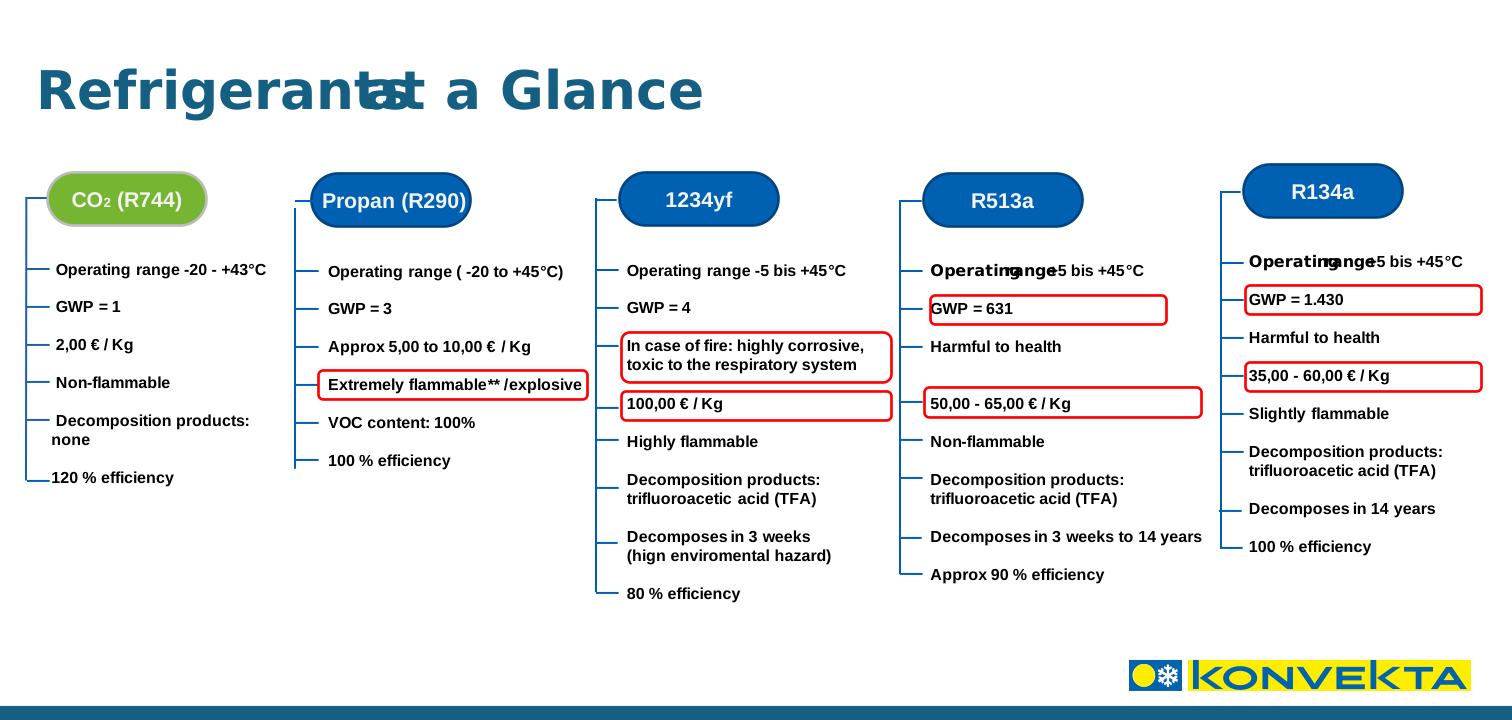
The consequences: These commercially available refrigerants are currently becoming very expensive and will no longer be available in the future.
Our Refrigerant Strategy
Konvekta gives preference to natural refrigerants such as CO₂ (R744) and propane (R290). Due to their low climate impact, they offer an attractive long-term foundation for modern air conditioning and thermal management systems.
However, the choice of refrigerant solution always depends on the specific application. Technical requirements, climatic conditions, safety considerations, vehicle architecture, and the availability of suitable components may necessitate different solutions. For this reason, Konvekta continues to use synthetic refrigerants in addition to natural refrigerants.